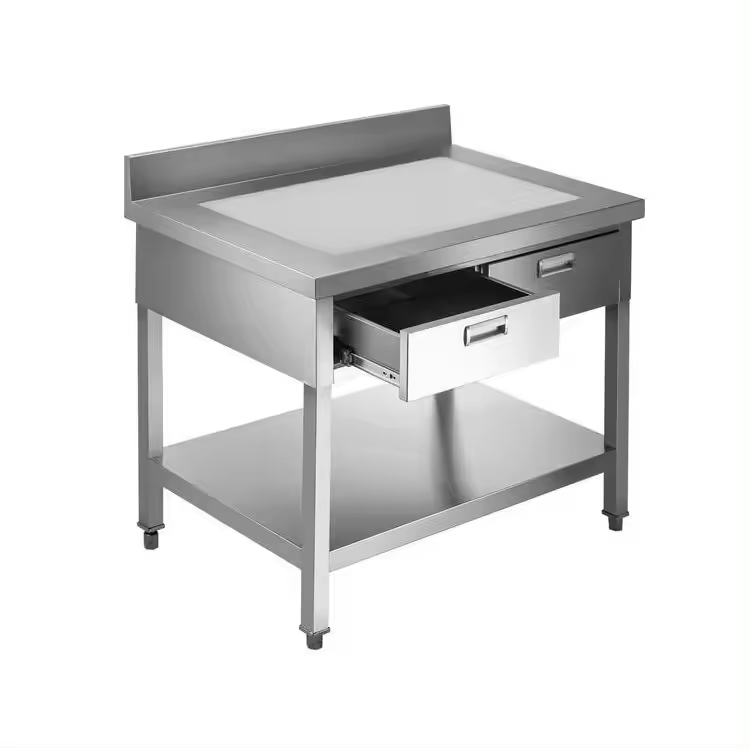
# 304 vs 201 Stainless Steel: Which Is Right for Your Kitchen?
When you are sourcing stainless steel kitchen equipment — whether it is a work table, a sink, a cabinet, or shelving — one specification quietly decides everything: the **grade of stainless steel**. For commercial kitchens, the two grades you will hear about most are **304** and **201**. On a spec sheet they look similar. In a real kitchen, they behave very differently.
This guide explains what 304 and 201 stainless steel actually are, how they compare, and which one you should choose for your commercial kitchen, restaurant, hotel, or food-processing operation. If you have ever wondered why two “stainless” tables have very different prices, this article is for you.
—
## What Is Stainless Steel, Really?
Stainless steel is not a single material. It is a family of iron-based alloys that contain at least 10.5% chromium. The chromium forms a thin, invisible “passive layer” on the surface that protects the metal from rust. The more chromium (and certain other elements like nickel), the stronger that protective layer becomes.
Most kitchen-grade stainless falls under the **300 series** (austenitic, with nickel) or the **200 series** (austenitic, with manganese replacing much of the nickel). **304** belongs to the 300 series. **201** belongs to the 200 series.
The practical difference comes down to **how much nickel and chromium** each grade contains — and that difference shows up as cost, corrosion resistance, and food-safety suitability.
—
## 304 Stainless Steel — The Food-Grade Standard
**304 stainless steel** (also called 18/8 stainless, because it contains roughly 18% chromium and 8% nickel) is the global benchmark for food-contact surfaces. It is the material you will find in professional kitchens, hospitals, breweries, and pharmaceutical plants.
### Key properties of 304
– **Chromium:** 18–20%
– **Nickel:** 8–10.5%
– **Corrosion resistance:** Excellent, even in wet, acidic, and salty environments
– **Magnetism:** Generally non-magnetic (a quick at-a-glance test)
– **Food safety:** Universally accepted for direct food contact
– **Formability & weldability:** Superior, which matters for custom fabrication
### Where 304 shines
Choose 304 wherever the surface touches food, water, or cleaning chemicals. That includes:
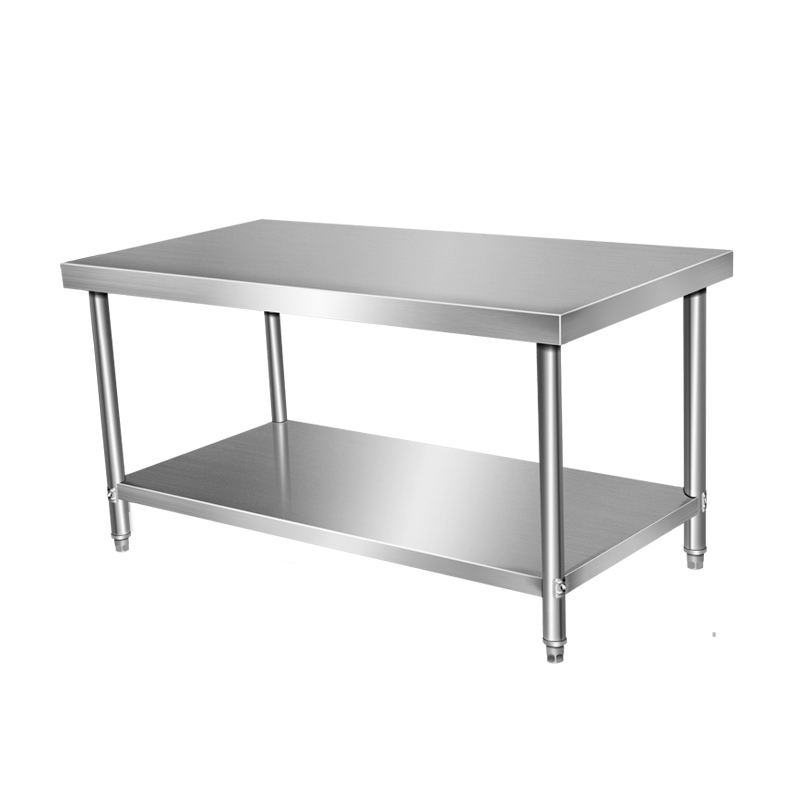
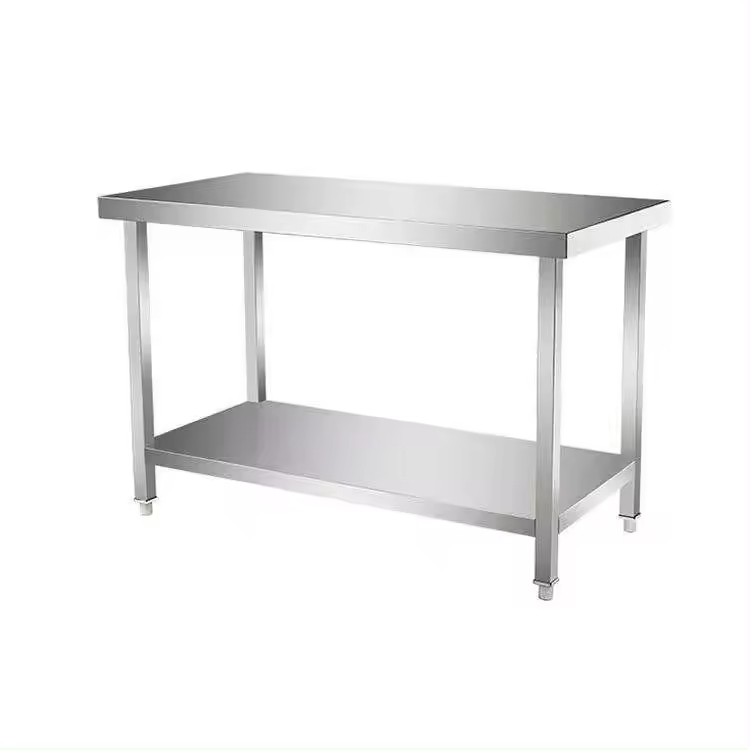
– **Prep and work tables** where raw meat, vegetables, and dough are handled
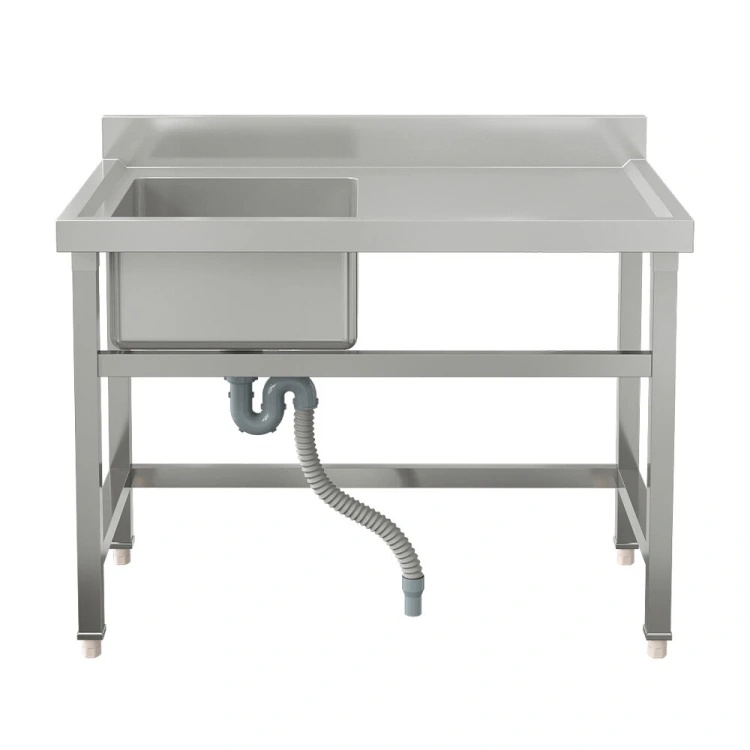
– **Commercial sinks** exposed to constant water and detergent
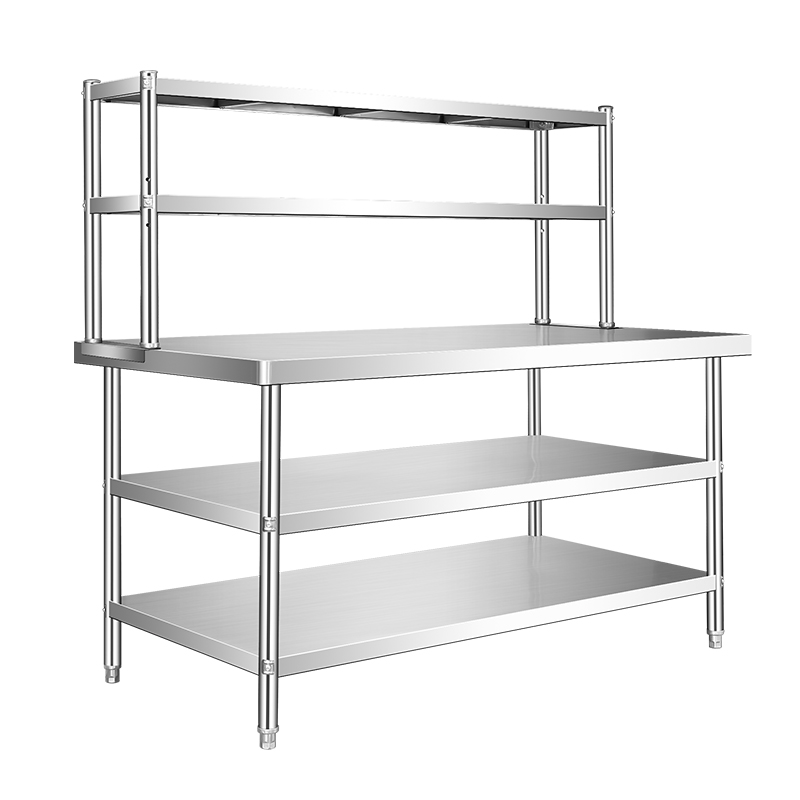
– **Cabinets and shelving** in humid dish rooms or walk-in coolers
– **Outdoor or coastal installations** where salt air accelerates corrosion
At GAOYA, our core work tables, sinks, and cabinets are built with food-grade **304 stainless steel**, and our key products are certified to ISO9001, CE, LFGB, and NSF standards — the certifications most international buyers require.
—
## 201 Stainless Steel — The Budget-Friendly Alternative
**201 stainless steel** was developed as a lower-cost alternative to 304. It replaces most of the expensive nickel with manganese and nitrogen. The result is a steel that is still “stainless” in appearance and reasonably durable, but with a weaker corrosion-resistance profile.
### Key properties of 201
– **Chromium:** 16–18% (slightly lower than 304)
– **Nickel:** 1–1.5% (drastically lower than 304)
– **Manganese:** 5.5–7.5% (the nickel substitute)
– **Corrosion resistance:** Good in dry, mild conditions; weaker in wet or acidic environments
– **Magnetism:** More magnetic than 304
– **Food safety:** Acceptable for non-critical, dry-contact uses; less common for certified food-contact lines
### Where 201 is acceptable
201 can make sense for:
– Decorative or structural parts that never touch food
– Dry-storage shelving in climate-controlled warehouses
– Budget-sensitive projects where the equipment stays dry and indoors
– Non-food back-of-house frames and supports
The main attraction of 201 is price — it typically costs **30–40% less** than 304. But in a working kitchen, that saving can disappear quickly if rust appears and the equipment needs early replacement.
—
## 304 vs 201: Side-by-Side Comparison
| Property | 304 Stainless Steel | 201 Stainless Steel |
|———-|———————|———————|
| Chromium content | 18–20% | 16–18% |
| Nickel content | 8–10.5% | 1–1.5% |
| Corrosion resistance | Excellent (food-grade) | Good, but lower |
| Rust risk in wet/salty areas | Very low | Higher over time |
| Magnetism | Generally non-magnetic | More magnetic |
| Typical cost | Higher | ~30–40% lower |
| Food-contact suitability | Yes, widely certified | Limited; dry/non-critical only |
| Best environment | Wet, acidic, outdoor, food-contact | Dry, indoor, structural |
—
## Which Should You Choose for Your Kitchen?
The right choice depends entirely on **where and how the equipment will be used**.
### Choose 304 if…
– The surface will **touch food** (prep tables, cutting stations, sinks)
– The equipment sits in a **wet or humid** area (dish room, cooler, near cooking line)
– You serve **acidic or salty** foods (citrus, vinegar, brine, seafood)
– You need **NSF / CE / LFGB** certification for import or inspection
– You want maximum **lifespan** with minimal maintenance
### Choose 201 if…
– The part is **structural or decorative**, not food-contact
– The environment is **dry and climate-controlled**
– Your project has a **tight budget** and a short expected service life
– You are equipping **back-of-house storage** that stays dry
**Rule of thumb:** If in doubt, choose 304. In a commercial kitchen, the cost of rust — failed inspections, replacement labor, food-safety risk — almost always exceeds the upfront saving of 201.
—
## How GAOYA Handles Material Selection
As a manufacturer with 19 years of stainless steel kitchenware experience and an 18,000㎡ factory producing 500,000 sets annually, we help buyers specify the right material for the right application. For international food-service clients, we default to **304 stainless steel** on all food-contact surfaces and reserve cost-optimized options for clearly non-critical components — always transparently labeled so you know exactly what you are buying.
Whether you need a single work table or a full container of OEM/ODM kitchen equipment, we can produce to your drawings or samples and supply the certification documentation required for your market.
—
## Final Verdict
– **304 stainless steel** is the safe, food-grade, long-term choice for any surface that meets food, water, or chemicals. It is what we recommend for the vast majority of commercial kitchen equipment.
– **201 stainless steel** is a valid budget option for dry, non-food, structural uses — but it should never be the default for prep surfaces or sinks.
Choosing the right grade is one of the simplest ways to protect both your budget and your food-safety compliance. If you are unsure which grade fits your project, talk to our team — we will specify it correctly the first time.
**👉 Need help choosing the right stainless steel equipment for your kitchen? [Contact GAOYA for a free quote](https://www.gaoyakitchenware.com/contact-us/) or browse our [stainless steel work tables](https://www.gaoyakitchenware.com/products-category/stainless-steel-work-table/), [commercial sinks](https://www.gaoyakitchenware.com/products-category/stainless-steel-sink/), and [kitchen cabinets](https://www.gaoyakitchenware.com/products-category/stainless-steel-working-cabinet/).**